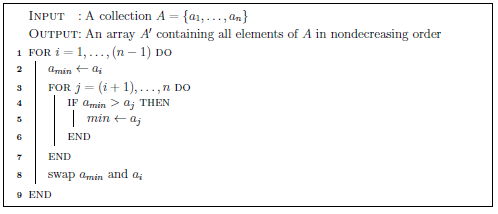
Iterate through the elements in the list and find the minimal element in the unsorted portion.
Swap the minimal element with the “first” element of the unsorted portion.
Repeat the process on the remaining $n - 1$ elements.
Note: Selection sort is not stable. For example, consider the sequence $2_a, 2_b, 1, 5$; the first swap would result in $1, 2_b, 2_a, 5$, changing the relative order of the $2$s.
Pseudocode
Analysis
Comparisons performed: once in the inner loop, executed multiple times by the outer loop.
In total: $$\sum_{i=1}^{n-1} \sum_{j=(i+1)}^n 1 = n(n-1) - \sum_{i=1}^{n-1} i = n(n-1) - \frac{n(n-1)}{2} = \frac{n(n-1)}{2}$$
Selection Sort has a time complexity of $O(n^2)$.
Code Samples
Code Sample 11: Java Selection Sort for integers
1
2
3
4
5
6
7
8
9
10
11
12
13
14
publicstaticvoidselectionSort(int array[]) { intn= array.length; for (inti=0; i < n; i++) { intindex_of_min= i; for (intj= i + 1; j < n; j++) { // Start inner loop from i+1 if (array[index_of_min] > array[j]) { index_of_min = j; } } inttemp= array[i]; array[i] = array[index_of_min]; array[index_of_min] = temp; // Corrected missing array variable } }